Why it's built this way
Headline
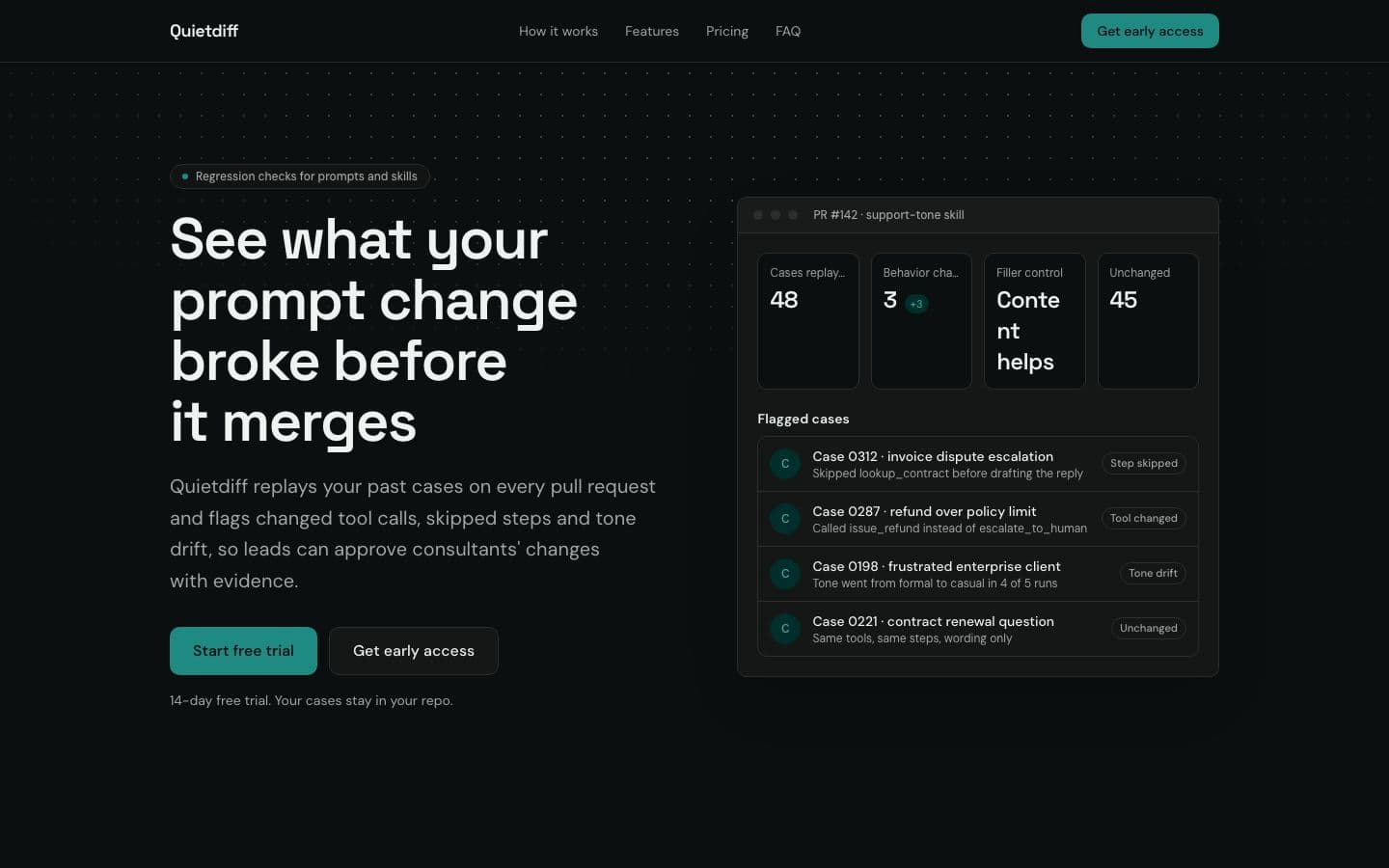
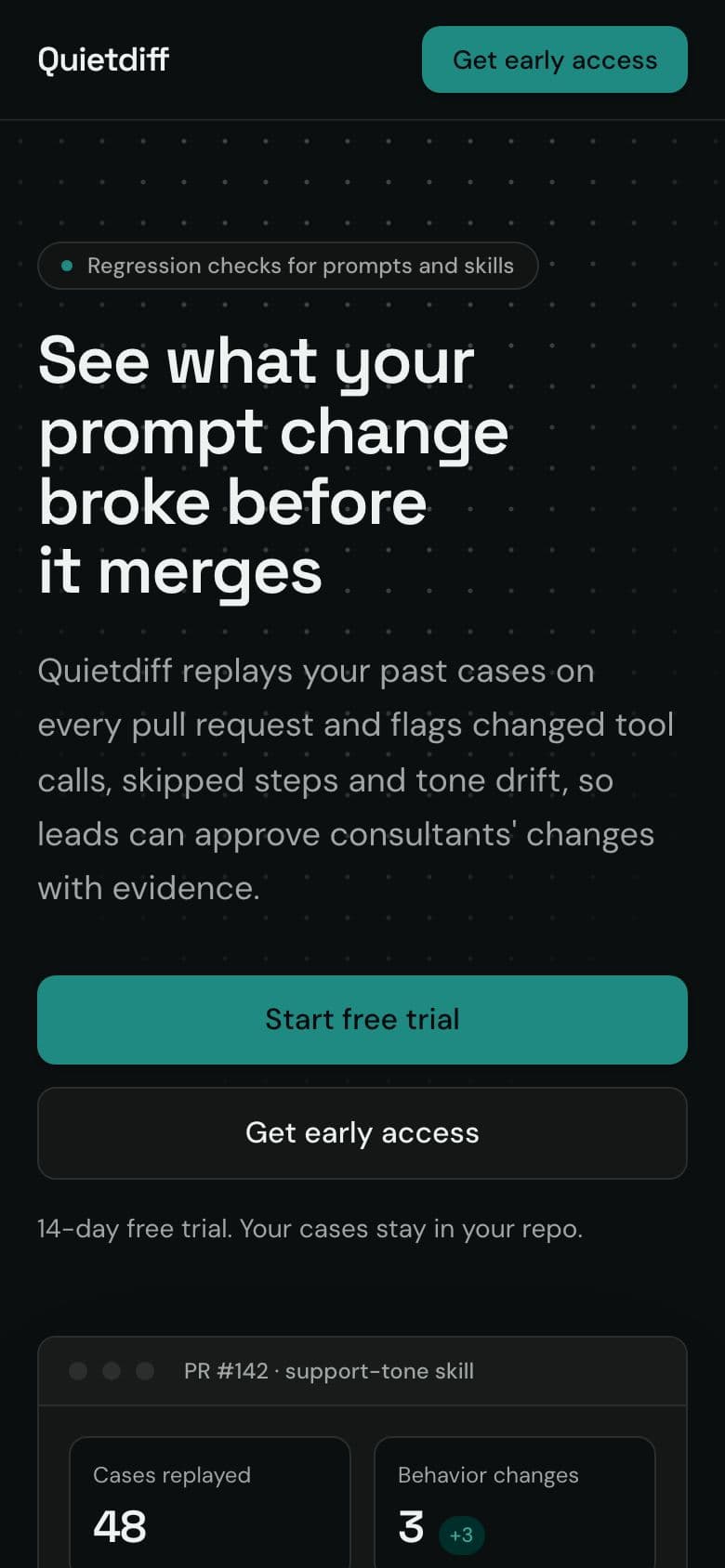
See what your prompt change broke before it merges
The people asking for a fix said they cannot tell whether a change made things worse. The headline promises exactly that answer, and "before it merges" names the moment they care about, since one person often acts as the review layer before anything merges.
Words it borrows from real posts:
- “quiet regression”
- “the review layer before anything gets merged”
- “text-only golden set”
- “skill vs no skill”
Sections, in order (12)
- Navigation: It gives leads quick jumps to how it works, features, pricing and FAQ, the parts a careful reviewer checks before trusting a tool.
- Hero: It states the promise and shows a sample report with skipped steps, swapped tools and tone drift. That makes the idea concrete. The figures are illustrative, since the product doesn't exist yet.
- Problem: It names the pains from the posts in the reader's own voice: being the review layer, an unchecked tone change, a golden set that misses changes, and skill vs no skill telling them nothing.
- How it works: Three short steps show the check fits where changes are already reviewed. This answers the worry that consultants who aren't engineers can't write eval code.
- Features: Each feature maps to a gap people described: behavior instead of text, a control for whether skill content matters, and automatic checks on every pull request.
- Who it's for: It names who the idea is for and who it is not for, so the test attracts the leads described in the posts and filters out solo projects.
- Comparison: It sets the idea against the two things people said they do today, reading diffs and a text-only golden set, and shows where each falls short.
- Founder's note: It retells the problem from the posts as a first-person reason to build. Ghostlaunch wrote it to test whether that story resonates, not as a real founder's history.
- Pricing: It keeps pricing simple, a trial and one team plan, so the test measures interest in the idea, not confusion over tiers.
- FAQ: It answers the objections a lead would raise: where client data lives, why a golden set is not enough, what the filler control does, and whether consultants must learn anything.
- Final call to action: It restates the cost of doing nothing, finding regressions late, and gives one more chance to click the trial button.
- Footer: It repeats the one-line promise in plain words, using the phrase quiet regression that people used for the core problem.
Price
- Free trial: Free
- Team: $99 a month
A free trial lets a lead test it on their own repo before committing. One team price, not per seat, fits a setup where many consultants write prompts and one lead reviews. The $99 figure tests whether a team will pay for that check.
Call to action
The button says Start free trial. After the click: Quietdiff is almost ready
"Start free trial" asks for a small, low-risk step that matches a lead wanting proof before trusting a tool. The click measures real intent. The dialog "Quietdiff is almost ready" tells them honestly that the product is not built yet.
Look
Brand colour #1F8A82, the “geometric” font pair, a dark theme.
A dark theme and a calm teal suit technical leads who live in code review tools. The geometric font pair reads as precise and orderly, which fits a product about careful, evidence-based checks rather than excitement.
The demand behind it
Quietdiff was built for a problem people keep posting about: Teams that write prompts, skills and agent workflows change them often, then cannot tell whether a change made things worse. The worst part is the "quiet regression" that nobody warns you about. Today one person often acts as the "review layer" before anything merges, and simple checks like "skill vs no skill" or a text-only golden set miss much of what changes.
“The people writing them are mostly technical consultants, not full-time engineers, and I'm currently the review layer before anything gets merged and used in the field.”
r/claudeai · 13 Oct 2026 · Read it on Reddit (How are you reviewing and approving AI skills / agent workflows before they ship to your team?) “Extra text on its own can change how the agent works, so "skill vs no skill" can't tell you whether the skill's actual content does anything.”
r/claudeai · 6 Oct 2026 · Read it on Reddit (I gave the 9 most popular Claude Code skills a sugar pill. 2 beat it, 1 did worse than the pill.)
Make one for your idea
Describe your idea and see who's asking for it. If you want, Ghostlaunch builds a page like this one and runs the 7-day test.
More AI examples
- Didrun · Agent Done Checker
- Diffrank · AI Code Review Queue
- Vettly · Security Check for AI Apps
- All AI landing page examples