
Why it's built this way
Headline
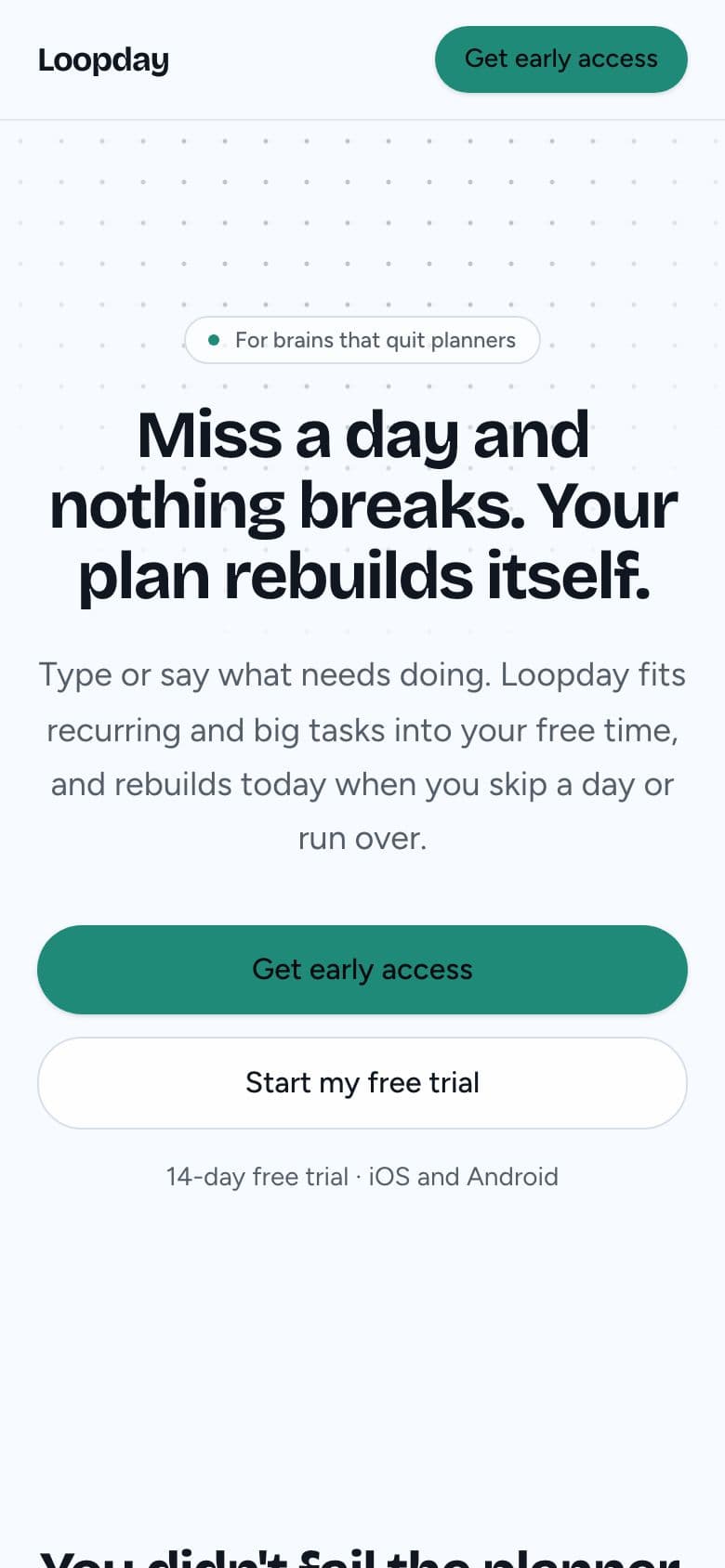
Miss a day and nothing breaks. Your plan rebuilds itself.
People said planners need constant upkeep and that one bad day ends the habit. The headline answers that fear first: a missed day costs nothing. The second line names the fix in plain words, so a person who wants something simple gets the promise in a single read.
Words it borrows from real posts:
- “daily steps”
- “Time blocking”
- “take longer than”
Sections, in order (11)
- Navigation: It keeps the page easy to scan and puts the early access button in reach from the top. People who find tools complicated get four clear places to go.
- Hero: It states the promise, shows a phone screen where yesterday's tasks are already moved into a gap, and names the trial and platforms, so the idea is concrete before any scrolling.
- Problem: It tells people they did not fail, the planner asked too much. Each pain echoes the posts: upkeep, repeating tasks, overrunning blocks, big work left until cramming.
- How it works: It shows setup happens once and the rest is opening today's plan. That answers the wish for a planner you don't have to keep maintaining.
- Features: Each feature maps to one request from the posts: no overdue pile, repeats said in plain words, big goals split into steps, and estimates that adapt to how long tasks really take.
- Who it's for: It names three groups from the posts: ADHD, busy job and life admin, students. It also says who should skip it, which makes the claims easier to trust.
- Comparison: It sets Loopday against list apps and work-focused schedulers on the points people raised: who decides when tasks happen, missed days, big tasks, and setup effort.
- Pricing: It keeps the choice to one plan with two ways to pay, so a person wary of complicated tools has nothing to compare or configure.
- FAQ: It answers the doubts someone with a planner graveyard would have: what happens after ignoring it, why this one would stick, setup time, devices, calendar data and cost.
- Final call to action: It repeats the core promise, a plan that stays current on bad days, and offers the same button once more at the point a reader has finished deciding.
- Footer: It restates in one line what Loopday is and who it is for, so the page ends on the same message it opened with.
Price
- Monthly: $8 a month
- Yearly: $60 a year
There is one plan so nobody has to weigh feature tiers. Monthly at $8 lets people try it after the free trial without a big commitment. Yearly at $60 costs less than twelve months, for those who expect it to stick. The price also sits below the scheduling tools in the comparison.
Call to action
The button says Get early access. After the click: Loopday is almost ready
Loopday does not exist yet. Ghostlaunch built this page to test the idea, so the button asks for early access, not a purchase. The click only shows interest, and the dialog says Loopday is almost ready. That honestly tells the visitor it is coming, not live.
Look
Brand colour #1F8A78, the “friendly” font pair, a light theme.
The deep teal-green reads calm and steady, not urgent, which suits people worn out by planners that shout overdue red at them. The friendly font pair and light theme keep the page soft and simple, matching the wish for something that is not complicated.
The demand behind it
Loopday was built for a problem people keep posting about: People keep dropping planners because keeping them up is a job in itself. They want something simple that repeats tasks "every X days," builds a routine around how they actually work, and breaks big goals or study loads into daily steps. Time blocking breaks down when a task takes longer than the gap between meetings.
“The reason I say this is because every calendar app is so complicated, and I just want something simple.”
r/notion · 11 Oct 2026 · Read it on Reddit (Is there any better way to make notion calendar work like a planner?) “I need an app that I could mention that every X days, I need to do Y.”
r/ProductivityApps · 5 Oct 2026 · Read it on Reddit (App to manage recurring tasks)
Make one for your idea
Describe your idea and see who's asking for it. If you want, Ghostlaunch builds a page like this one and runs the 7-day test.
More SaaS examples
- Postwise · First Customers Finder
- Stallwatch · Signup Drop-off Diagnosis
- Proofkeep · Compliance Evidence Collector
- All SaaS landing page examples